
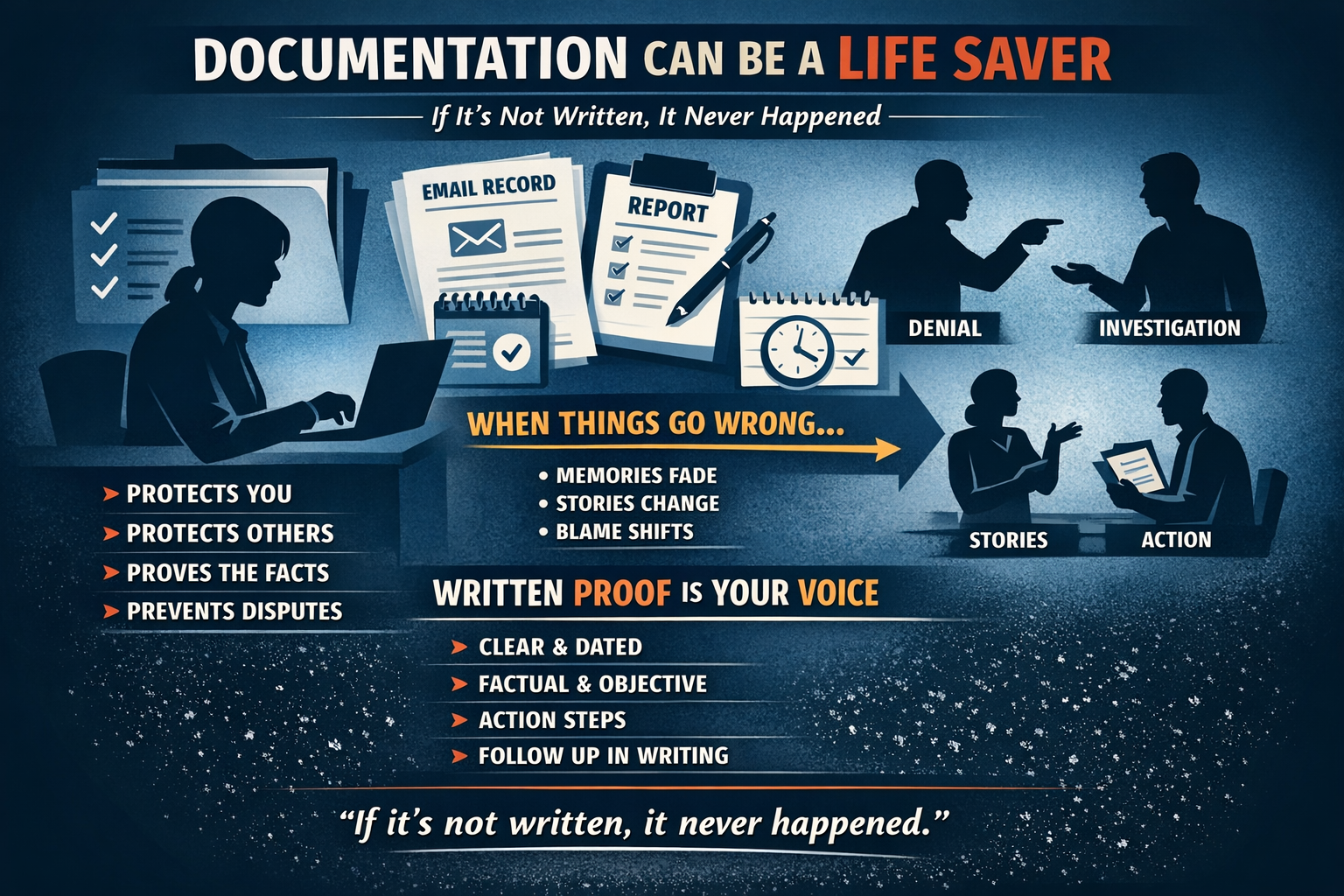
In one of my professional trainings, a statement was repeated so firmly that it stayed with me long after the session ended:
“If it’s not written down, it never happened.”
At first, it sounded harsh. Almost exaggerated. After all, we talk to people every day. We give instructions verbally. We make agreements in meetings. We resolve issues through conversations. Surely that should count for something.
But with experience, I learnt the hard way that it doesn’t.
Documentation is not just paperwork.
It is not bureaucracy.
It is not “extra work.”
Documentation is protection. Documentation is evidence. Documentation is power.
And in many situations, it can be a life saver professionally, legally, and emotionally.
The Illusion of Verbal Agreements
Many problems begin with good intentions.
“I told her already.”
“We discussed it.”
“He knows.”
“She agreed.”
But when things go wrong, verbal agreements disappear into thin air.
Memories become selective.
Stories change.
Responsibility is denied.
Suddenly, you are standing alone, trying to explain something that no longer has proof.
This is where documentation steps in.
A written record does not rely on memory.
It does not depend on emotions.
It does not change its story.
It simply exists.
I’ve watched people lose their jobs not because they were careless, but because they trusted verbal communication in a system that only respects written evidence.
I’ve also watched people remain calm during investigations because they knew one thing: “Everything I did is documented.”
That confidence is different.
Documentation doesn’t make you difficult.
It makes you safe.
It doesn’t mean you expect trouble.
It means you understand reality.
Because when things go wrong—and sometimes they will—documentation becomes your voice when you’re no longer in the room.
So write it. Send the email. Document the concern. Follow up in writing.
One day, it may be the only thing standing between you and a very unfair outcome.
I’ve seen it.
More than once.
If it’s not written, it never happened.
Emails Have Saved Me More Times Than I Can Count
I have personally experienced situations where my documentation—especially emails—saved me.
Not because I wanted to prove someone wrong.
Not because I wanted conflict.
But because I needed truth.
There were moments where instructions were denied, timelines were questioned, and accountability was avoided. In those moments, a simple email thread changed everything.
An email with:
A date
A time
Clear wording
Agreed actions
Suddenly, the conversation was no longer about opinions.
It was about facts.
And facts don’t argue. They stand.
Documentation Protects the Vulnerable
In sectors like health, care, education, corporate leadership, and social services, documentation is not optional—it is ethical responsibility.
Good documentation:
Protects service users
Protects staff
Protects organisations
Protects families
Protects professionals from false accusations
When incidents happen, emotions run high. People look for answers. Without documentation, blame becomes a guessing game.
With documentation, there is clarity.
Documentation Is Not Distrust — It Is Professionalism
Some people say,
“Why are you writing everything? Don’t you trust me?”
This mindset is dangerous.
Documentation is not about distrust.
It is about standards.
Just like seatbelts are not an insult to driving skills, documentation is not an insult to character.
It is there for:
Continuity
Accountability
Transparency
Safety
A professional who documents is not difficult.
They are prepared.
When Things Go Wrong, Documentation Speaks for You
One of the most painful professional experiences is being accused of something you did not do—or being blamed for something you raised but was ignored.
In those moments:
Your voice may shake
Your emotions may betray you
Power dynamics may work against you
But your documentation will speak clearly and calmly on your behalf.
It will show:
What you observed
What you reported
When you reported it
Who was informed
What actions were suggested or taken
That is not overdoing it.
That is self-preservation.
“If It’s Not Written, It Never Happened”
This statement is not meant to scare you.
It is meant to prepare you.
Because in real life:
People forget
People deny
People shift blame
People protect themselves
Documentation ensures you are not left exposed.
What Good Documentation Looks Like
Good documentation is:
Clear, not emotional
Factual, not assumptive
Timely, not delayed
Professional, not personal
It answers:
Who?
What?
When?
Where?
What action was taken?
What action is required?
No insults.
No exaggeration.
No unnecessary storytelling.
Just truth.
Documentation Builds Confidence
When you document properly, you walk differently.
You speak with clarity.
You are not afraid of reviews, audits, or investigations.
You don’t panic when questions are asked.
Because you know: Your work is recorded. Your actions are traceable. Your integrity is visible.
That confidence is priceless.
A Final Word
Documentation is not about being defensive.
It is about being wise.
It is not about preparing for conflict.
It is about preparing for reality.
I have seen documentation save careers.
I have seen it protect vulnerable people.
I have seen it shut down false narratives.
I have seen it bring truth to light.
So document. Send that email. Write that note. Record that observation. Follow up in writing.
Because one day, you may need it.
And when that day comes, you will be grateful you wrote it down.
If it’s not written, it never happened.